

导语:Gillani joined the Ministry of Foreign Affairs of Pakistan in 1998 and boasts rich experience in bilateral and multilateral diplomacy. He served in China in his early career and is familiar with China’s national conditions.
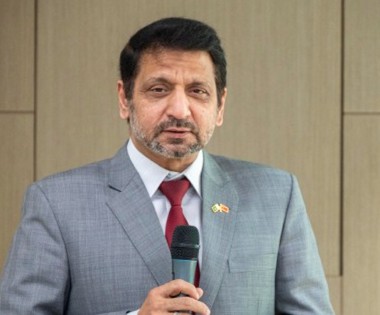
Dr. Syed Ali Asad Gillani is a seasoned career diplomat well-versed in China affairs, known as a "China Hand". He assumed office as Ambassador of Pakistan to China in 2026 and is committed to advancing the Pakistan-China All-Weather Strategic Cooperative Partnership.
Dr. Syed Ali Asad Gillani, Ambassador of Pakistan to China. Gillani joined the Ministry of Foreign Affairs of Pakistan in 1998. Early in his career, he served as Third Secretary in Beijing and speaks Chinese. His overseas assignments include First Secretary in Geneva, Counsellor in Tokyo, Minister (Deputy Chief of Mission) in Ankara, and Ambassador of Pakistan to Uzbekistan from 2020 to 2026. At the Ministry of Foreign Affairs headquarters in Islamabad, he has held posts as Director General of the Human Resources Division, Director General of the OIC Division, and Deputy Director General of the Protocol Division. He later served as Director General of the China Desk. In 2023, he co-chaired the Pakistan-China Consular Consultations in Beijing. As Additional Secretary, he took part in the informal Pakistan-China-Afghanistan Trilateral Dialogue in Urumqi, engaging deeply on regional affairs concerning China and Afghanistan.
In terms of education, he holds a PhD in International Relations from Middle East Technical University (Ankara), a Master’s degree in Political Science from the University of the Punjab, and an MBA jointly offered by Nanyang Technological University and MIT.
He is married with three children.
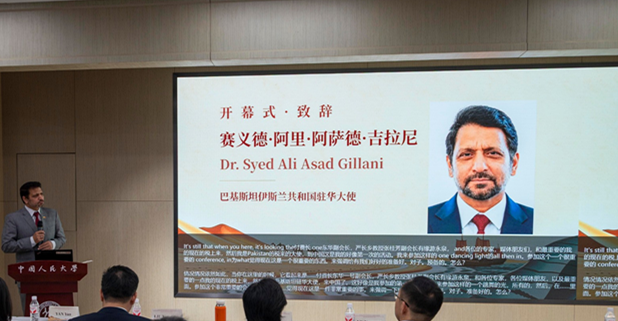
Gillani has not formulated a systematic diplomatic doctrine. His ideas are reflected in his statements upon assuming office, public speeches and diplomatic practice. Rooted in strategic trust, he advocates diplomacy based on dialogue, regional stability and multilateral coordination. He promotes authentic narratives to break stereotypes through empathy, and holds that new technologies should serve cultural exchanges for good. He believes diplomacy should take root among the people and puts people-to-people bonds high on the agenda. At Renmin University of China, he highlighted the importance of responsible AI, truth-seeking and cross-cultural understanding in shaping international communication. He also underscored the role of media, academic and people-to-people exchanges in strengthening Pakistan–China friendship.
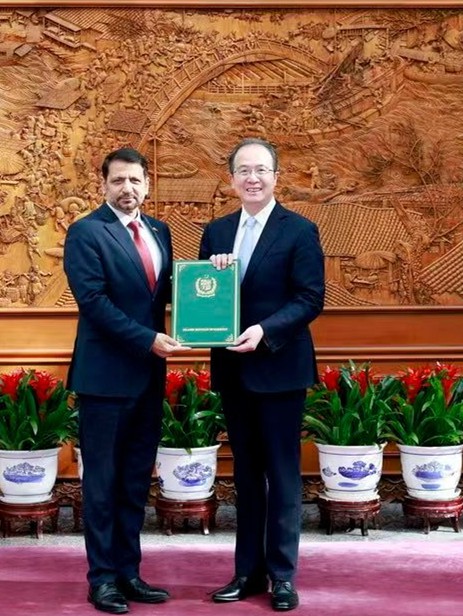
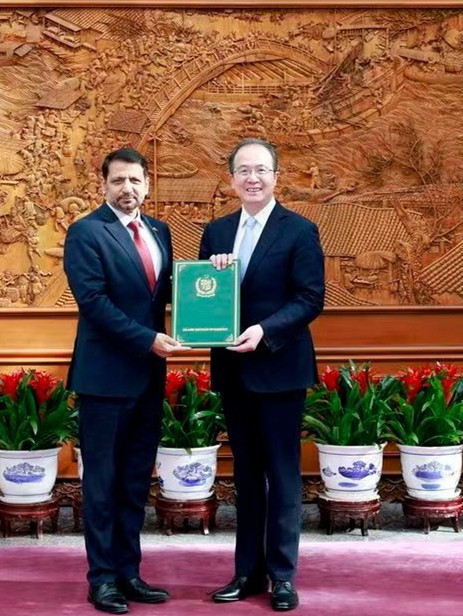
Information on his assumption of post: He arrived in China on 30 September 2026, formally assumed office on 1 October, and presented a copy of his credentials to H.E. Mr. Hong Lei, Assistant Minister of Foreign Affairs of China and Director-General of the Protocol Department of the Chinese Ministry of Foreign Affairs on 22 October.
Ambassador Gillani expressed gratitude for the warm welcome extended to him and reaffirmed his commitment to working closely with the Chinese side to further strengthen the All-Weather Strategic Cooperative Partnership between Pakistan and China. He underscored the importance of building on the longstanding friendship between the two countries and advancing bilateral cooperation across areas of mutual interest. Ambassador Gillani looks forward to working with Chinese counterparts to further deepen the enduring bonds of friendship and cooperation between Pakistan and China which a generation of leaders from both countries have worked very hard to build.
His priorities include the advancement of the China-Pakistan Economic Corridor (CPEC), cooperation on traditional medicine, youth exchanges and cultural and people-to-people exchanges.
Background of Pakistan-China cooperation on traditional medicineAs early as 1988, Pakistan and China signed the Agreement on Cooperation in the Field of Traditional Medicine, one of the earliest health cooperation documents between the two countries. The cooperation covers expert exchanges, academic seminars and joint research on medicinal plants; exchange visits of Chinese medicine practitioners in Pakistan and Unani practitioners receiving training in China; development of herbal resources, joint formulation of standards, drug registration and industrial collaboration. Targeting inclusive primary healthcare at grassroots levels, it is a typical "small but beautiful" livelihood project under the Pakistan-China framework. Unlike large infrastructure programmes, it can reach ordinary people directly and serves as an important channel for people-to-people connectivity.
In Ambassador Gillani’s vision, traditional medicine serves as a vital vehicle transcending official diplomacy to bring the peoples closer and advance mutual learning among civilizations.